Fly brain only — first feedback test
Research record
- Question
- Does the original fly spiking circuit produce the motor events in a minimal closed loop, without a separate behavioral policy?
- Evidence
- Pinned Shiu/Spiller official model and sugar-neuron example, all seven original source/data Git blobs verified unchanged. Complete model: 127,400 neurons and 14,687,178 synapse rows. MN9 is the defined feeding readout.
- Experiment
- Executed on Linux: seeds 20261041–43, intact/sensory-block/MN9-incoming-cut/restored, one simulated second each. Fixed candidate sugar pulses at 150Hz across 21 official sensory IDs, 0.1ms neural dt, 10ms feedback. Each recorded MN9 spike consumes one of 50 abstract resource units; local food availability gates subsequent sensory input.
- Results
- All three intact/restored pairs consumed 50 units; all sensory/motor cuts consumed zero. Intact MN9 counts were 52, 50 and 54. Each restore matched the complete intact spike train, weight hash and feedback trajectory. Independent raw-event accounting passed all 1,200 feedback windows.
- Limitations
- A designed contact-feeding reflex with engineered input/actuator gains, not goal selection, food search, turning, driving, biological-body validation, learning or consciousness. Original fixed weights retained. External code still supplies sensory encoding and an abstract actuator; it does not choose actions.
- Reproduction
- Run source, preserved preregistration, environment lock, original source manifest, full raw spike and candidate-input records, independent validator, all feedback windows and file hashes are linked. The original dataset remains at the author source; no reduced surrogate or learned controller is used.
Sources
- Shiu/Spiller pinned official model
- Official sugar-neuron and MN9 example
- Embodied brain integration and its external controller limitations
Run evidence
2026-10-28 · Correcting the controller boundary
Task: The fly neural circuit must be the only source of motor output. External code supplies the world, sensory encoding and a fixed actuator conversion. It must not choose a goal, plan a route or supply a learned body policy.
The earlier learning-bug journal uses a separate Q-learning policy. The Seoul prototype uses SUMO driving rules and route finding. Those are supporting software demos; neither satisfies this brain-only requirement. Their records remain available, but they are removed from the current task list.
Loop: Local food contact → the official 21 sugar sensory neurons → the full original fly spiking circuit → MN9 spikes → abstract resource consumption → updated food availability.
No Q-table, scripted goal priority, route planner, LLM, SUMO driver or pretrained body controller sits in that action path. The 466-neuron reduced candidate is not used.
Executed on Linux
The official model and example are pinned to commit 91bdd1e7dcf193f3e7ca5a8933497fcef63b7960. All seven original source/data blobs matched before and after execution. Every condition retained 127,400 neurons and 14,687,178 synapse rows.
Three seeds, four conditions, one simulated second per condition; 0.1ms neural time steps. A candidate sensory pulse train is fixed for each seed. Every 10ms the world gates those pulses according to whether contacted food remains. Neural state continues between windows. Actual admitted inputs can differ once actions change the environment; this is feedback, not an identical-input open-loop comparison.
The actuator consumes one abstract unit per recorded MN9 spike, clipped at zero from an initial 50 units. The 150Hz input gain, unit conversion and initial resource quantity are engineered settings, not measurements of physical food or muscles.
| Condition | MN9 spikes · seed 41 / 42 / 43 | Resource consumed · each seed |
|---|---|---|
| Original circuit | 52 / 50 / 54 | 50 / 50 / 50 |
| Sensory input blocked | 0 / 0 / 0 | 0 / 0 / 0 |
| All incoming MN9 weights cut | 0 / 0 / 0 | 0 / 0 / 0 |
| Incoming MN9 weights restored | 52 / 50 / 54 | 50 / 50 / 50 |
Full seeds are 20261041, 20261042 and 20261043. The motor intervention zeros weights on all 229 incoming MN9 synapse rows. The recovery condition restores those original weights before a separate run; it is not recovery from damage during the same run. Other neurons remain active in the motor-cut condition; the intervention does not simply stop the whole model.
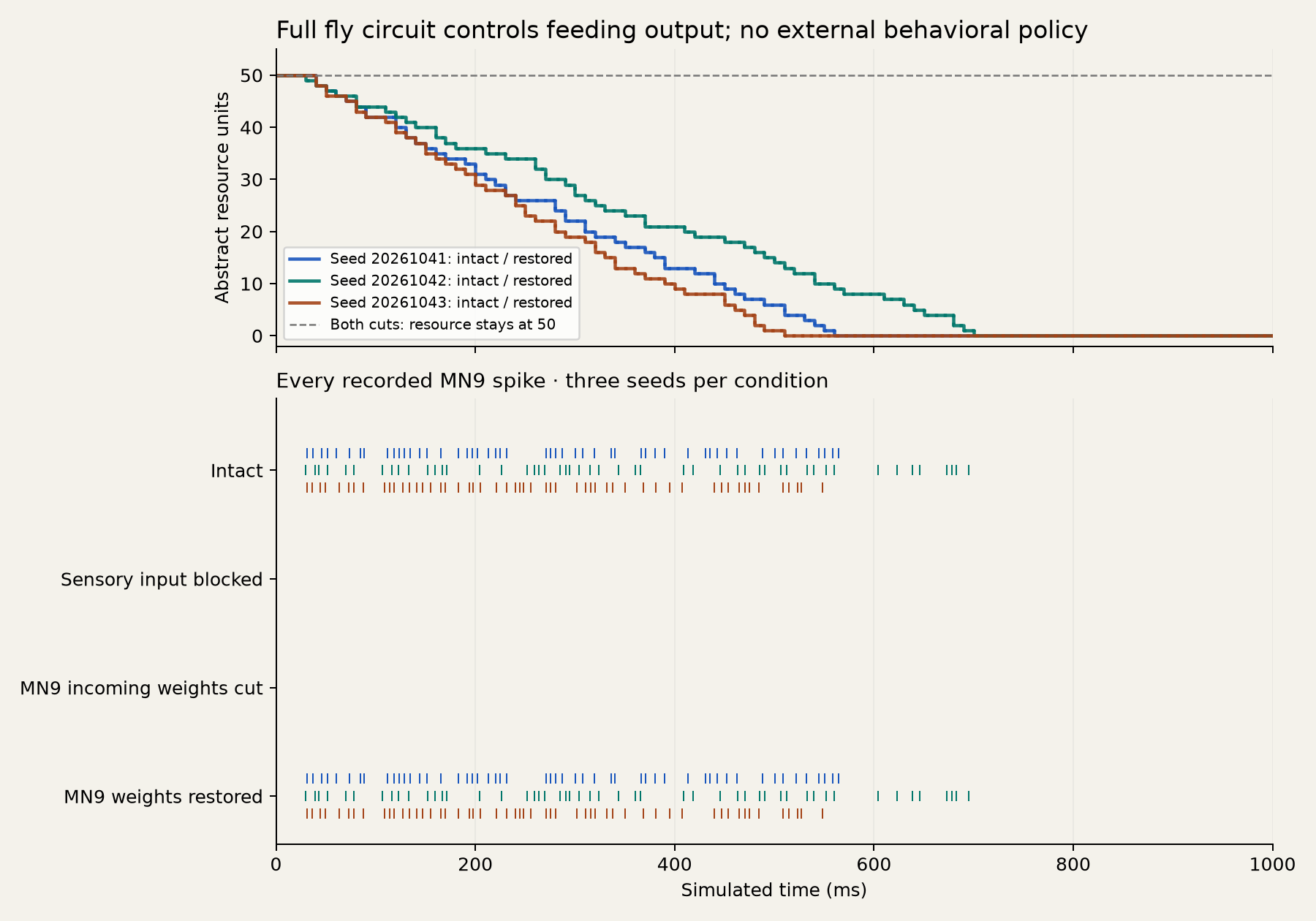
All three restorations matched the intact complete neural spike events, weights and feedback trajectories. An independent validator reconstructed every consumption event, sensory gate and resource balance from raw records: 12 trials and 1,200 windows passed. Model execution and result assembly took 229.45 seconds on Linux; maximum process RSS was approximately 3.04 GiB. The protocol and all trials, including zero-output conditions, are preserved.
What this establishes
This is a minimal engineered sensory–motor feedback check. It establishes that these modeled motor events depend on the original circuit’s sensory drive and MN9 input path, with a fixed decoder. The conversion from a motor spike to a resource unit is part of the experimental apparatus; it is not a discovered feeding law.
It does not establish intelligent goal selection, learned behavior, resource search, walking, turning or driving. No plasticity was added. A behavioral policy must not be smuggled into the sensory encoder or actuator in later experiments.
Follow-up: The bilateral steering identification has now been executed. Both sensory screens failed the direction criterion; the body and brain-controlled driving remain unexecuted. The feeding result above is unchanged.
The Eon integration report itself describes external body controllers and hand-chosen mappings; that entire stack cannot be treated as evidence that this stricter controller boundary has already been met.
Evidence & reproduction
Run summary · independent validation · all spike events · candidate inputs · preserved preregistration · runner · instructions and raw downloads · file hashes.
Update record
-
2026-10-28: Corrected the project goal to neural-circuit-only behavioral control. Executed the full-model contact-feeding feedback test and all cuts/restores on Linux, verified raw events independently, and published evidence. External-policy demos are retained as supporting work. Steering and brain-driven Seoul travel remain not run.
-
2026-10-28, steering follow-up: Published48 sensory trials and six direct controls in a separate record. Both steering criteria failed; the current task now follows that unresolved output asymmetry. No feeding rerun is implied.