Fly brain only — steering identification failed
Research record
- Question
- Does the full fly circuit with preserved wiring and weights produce a left-positive DNa02 difference for left sensory drive and a right-positive difference for right drive?
- Evidence
- Pinned FlyWire 630 annotation v1.1.0 identifies bilateral DNa02 and sensory nerve-entry sides; published walking physiology supports an ipsiversive sign. Original full Shiu/Spiller model and seven source/data blobs retained.
- Experiment
- Linux: broad antennal olfactory drive, seeds 20261051–53, then a literature-selected DM1-only follow-up with heldout seeds 20261071–73. Each screen: none/left/right/bilateral/left-cut/left-restored/right-cut/right-restored; one second each. Six separate direct DNa02 controls use seeds 20261061–63. Follow-up: saved-data attribution and upstream-conditioned two-output trace replay for all 48 sensory trials; no new full-network intervention.
- Results
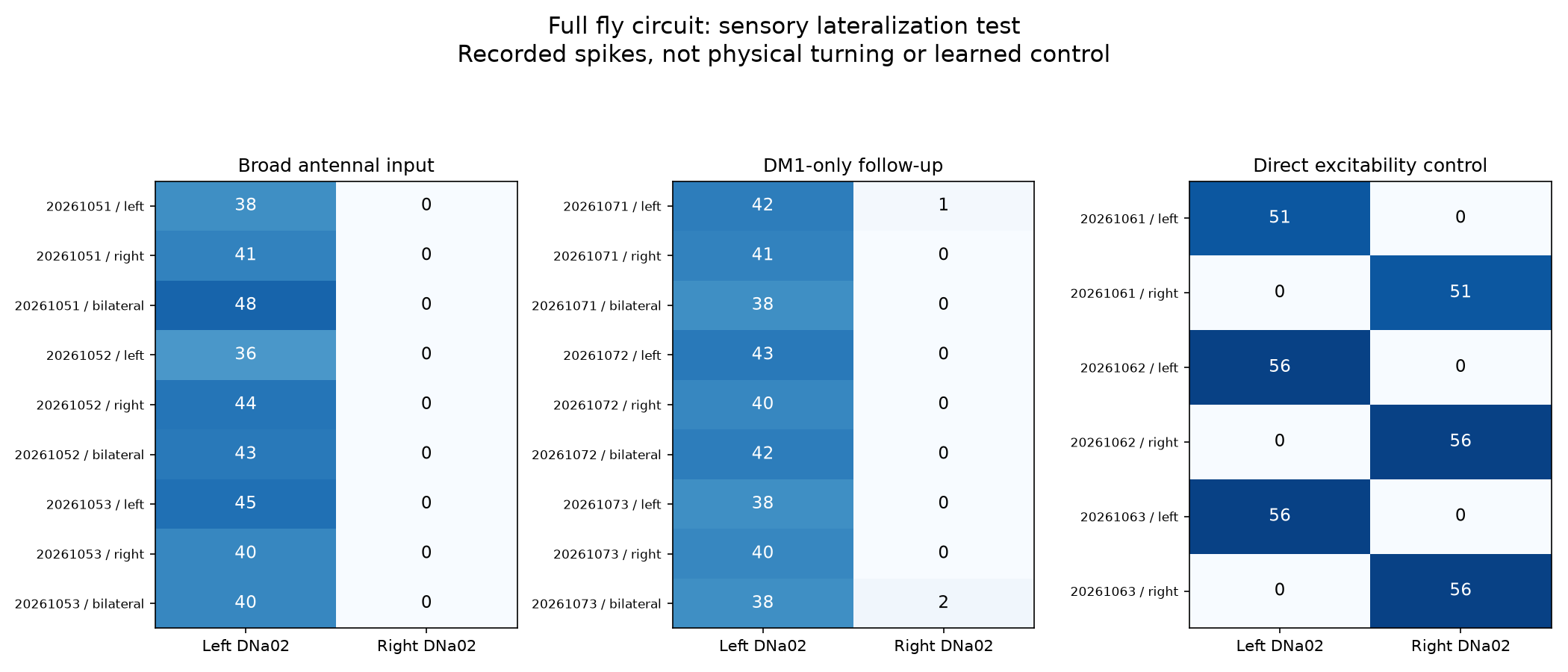
- Both sensory screens failed the prespecified direction criterion. All right-only trials had a left-positive output difference. Every sensory cut yielded zero DNa02 spikes, 12 full-event restore pairs matched exactly, and direct stimulation elicited 51/56/56 spikes from either stimulated DNa02. All48 conditioned target spike-time sequences match. A 630-annotated AOTU019-left source leads negative weighted arrivals to right DNa02 in all 18 intact conditions across six seeds, contributing 43.75–48.31% of that nominal negative dose. This source has not been causally tested.
- Limitations
- Open-loop identification, not movement, closed-loop steering, route finding or learning. Engineered sensory gains; broad input is not an exact Orco preparation. DM1 side and total drive differ from broad input, so the follow-up cannot isolate the cause. Underlying asymmetry is unresolved. Reconstructed voltage states are derived with archived upstream spikes clamped, not originally recorded membrane traces or an independent predictive two-cell substitute. Weighted arrivals are before decay/refractory handling; source ranking is retrospective.
- Reproduction
- All 54 trials, raw full-network spike Parquets, paired candidates, selections, original source manifest, protocols, runners and independent saved-data audits are downloadable. Audit pass is separate from hypothesis failure. Separate attribution release includes incoming weights, all 48 reconstructed traces, 71,664 source/trial rows and an independent saved-data audit.
Sources
- Source, protocols and all 54 trial downloads
- All trial results
- Rayshubskiy et al.2025 — DNa02 sensory steering
- Yang et al.2024 — descending steering control
- Semmelhack and Wang2009 — DM1 attraction
- Pinned630 annotation columns and side definitions
- Pinned author LIF equations and input convention
Run evidence
Task · identify left and right output
Result: the sensory steering criterion failed. Left and right sensory inputs both produced predominantly left DNa02 activity. No body, vehicle, route planner or learned controller was attached. The feeding feedback baseline remains a separate successful apparatus check.
Executed · 54 Linux trials
The full original model retains its wiring and fixed synaptic weights: 127,400 neurons, 14,687,178 synaptic rows, fixed weights, author commit 91bdd1e7dcf193f3e7ca5a8933497fcef63b7960. All seven original source/data blobs matched before and after each sensory screen.
The pinned v1.1.0 annotation explicitly uses FlyWire 630 IDs. It identifies DNa02 left 720575940629327659 and right 720575940604737708. The later v2.1 annotation retains these IDs and sides; it is a crosscheck, not a replacement sensory dataset. Walking physiology supports turning toward the DNa02 soma side. The prespecified readout is left minus right spikes, with no fitted sign or gain.
Each sensory screen used three seeds and eight conditions. Every run starts fresh: 200 ms quiet, 500 ms synthetic sensory drive, 300 ms settling, 0.1 ms neural steps. Counts below cover 200–1000 ms. Candidate pulses and neural seed are identical across each intact/cut/restore comparison. Sensory neurons use the author’s stimulation convention: their refractory period is set to 0 ms; the other cells keep the default 2.2 ms. The local protocols were fixed before their respective runs; this is not an external preregistration.
- Broad: all model-present antennal olfactory sensory cells, 1,037 left and 1,052 right. Two annotated IDs absent from this model were excluded and recorded. Equal expected aggregate rate 50,000 Hz/side. This is not an exact replication of the Orco sensory-steering preparation.
- DM1 follow-up: a single class selected from published Or42b/DM1 vinegar-attraction evidence, using new seeds rather than selecting a class by its simulated response. All 35 left / 33 right annotated cells are present. Equal expected aggregate rate 4,950 Hz/side, at most 150 Hz per cell. The different population and drive are a new operating point, not a controlled isolation of the first failure’s cause.
| Set / seed | Left input L / R | Right input L / R | Bilateral L / R |
|---|---|---|---|
| Broad / 20261051 | 38 / 0 | 41 / 0 | 48 / 0 |
| Broad / 20261052 | 36 / 0 | 44 / 0 | 43 / 0 |
| Broad / 20261053 | 45 / 0 | 40 / 0 | 40 / 0 |
| DM1 / 20261071 | 42 / 1 | 41 / 0 | 38 / 0 |
| DM1 / 20261072 | 43 / 0 | 40 / 0 | 42 / 0 |
| DM1 / 20261073 | 38 / 0 | 40 / 0 | 38 / 2 |
All right-only inputs gave a positive difference, contrary to the required negative sign. Neither screen passed. DM1 has two small nonzero right-cell exceptions: seed 20261071 left input produced one right spike, and seed 20261073 bilateral input produced two. Neither exception established direction-selective output.
Checks · cuts, restoration and excitability
The cuts zero both DNa02 incoming weight sets: 742 left and 751 right rows, without removing neurons or rows. All 12 cut trials produced zero DNa02 spikes, while 397,902–399,139 other spikes remained in broad runs and 359,584–361,542 in DM1 runs. The circuit was active beyond the output pair. Each of 12 restorations matched its intact entire network spike-event sequence and weight hash. Restoration occurs before a fresh run; it is not in-run healing.
A separate direct-stimulation diagnostic tested whether the right cell could spike at all. With the same pulse schedule per side and seed, direct left/right stimulation produced 51/51, 56/56 and 56/56 spikes in the stimulated cells; unstimulated DNa02 cells stayed silent. Original weights and the motor cells’ default 2.2 ms refractory periods remained intact. This establishes excitability under artificial direct drive. It does not repair or validate the sensory pathway and is not used as a steering policy.
Independent saved-event audits reconstructed all six sensory candidate schedules, recounted 48 sensory trials and six direct controls, and checked the 12 full-event restore pairs. Data audit: pass. Sensory direction hypothesis: fail. These audits do not independently rerun the brain model. Sensory simulations and result assembly took 100.54 s broad and 96.66 s DM1; the diagnostic took 31.43 s. Maximum sensory-process RSS was approximately 3.00 GiB, with one native worker at low priority and no GPU.
Saved-data attribution
2026-10-28 · Analysis, not a new steering experiment. The right output receives substantial positive input, but negative weighted arrivals dominate in all six right-only trials. The model ID/index mappings match the original connection table. There are 742 left-output and 751 right-output source rows, sharing 82 source cells; none of the 1,411 selected annotation IDs is duplicated.
Two output cells were replayed with the original archived upstream spike trains fixed, using the author’s equations, weights, 1.8 ms delay, reset and 2.2 ms motor refractory period. Both target spike-time sequences matched the original recordings in all 48 sensory trials at 0.1 ms resolution. This is conditional trace reconstruction. It is not 48 new full-network experiments, an independent prediction, or a validated smaller brain/controller. The original full-network membrane traces were not recorded.
| Set / seed | R negative / positive weighted arrivals | R max reconstructed voltage (mV) |
|---|---|---|
| BROAD / 20261051 | 1.43 | -45.974 |
| BROAD / 20261052 | 1.34 | -49.530 |
| BROAD / 20261053 | 1.36 | -49.093 |
| DM1 / 20261071 | 1.39 | -45.667 |
| DM1 / 20261072 | 1.42 | -48.630 |
| DM1 / 20261073 | 1.42 | -51.910 |
The right-cell reconstructed maxima remain below the model’s −45 mV threshold. Its model-g input state is negative for 71.7–76.8% of the 200–1000 ms window in these six trials. Here, model-g has voltage units; weighted-arrival sums are nominal signed weight×source-spike counts before decay, timing and refractory handling, not membrane voltage, biological current or a causal effect size.
The largest negative weighted-arrival contributor is consistently source 720575940627100584, labelled AOTU019, left in the pinned 630 hemibrain_type annotation. It contributes 43.75–48.31% of nominal negative weighted arrivals to right DNa02 in 18 intact conditions across six seeds. Conditions within each seed are paired; this is a retrospective ranking, not 18 independent causal tests.
The candidate→right DNa02 connection is one model row aggregating 216 contacts, with signed weight −59.4 mV. It also has a separate one-contact row to left DNa02. The right-side cell of the same annotated type, 720575940631517251, has 121 contacts to left DNa02. In the first broad right-input case, the two sources contribute 99 and 66 arriving spikes respectively. These asymmetries nominate a focused test; they do not establish that this cell causes the failure or that removing it would restore direction-selective steering.
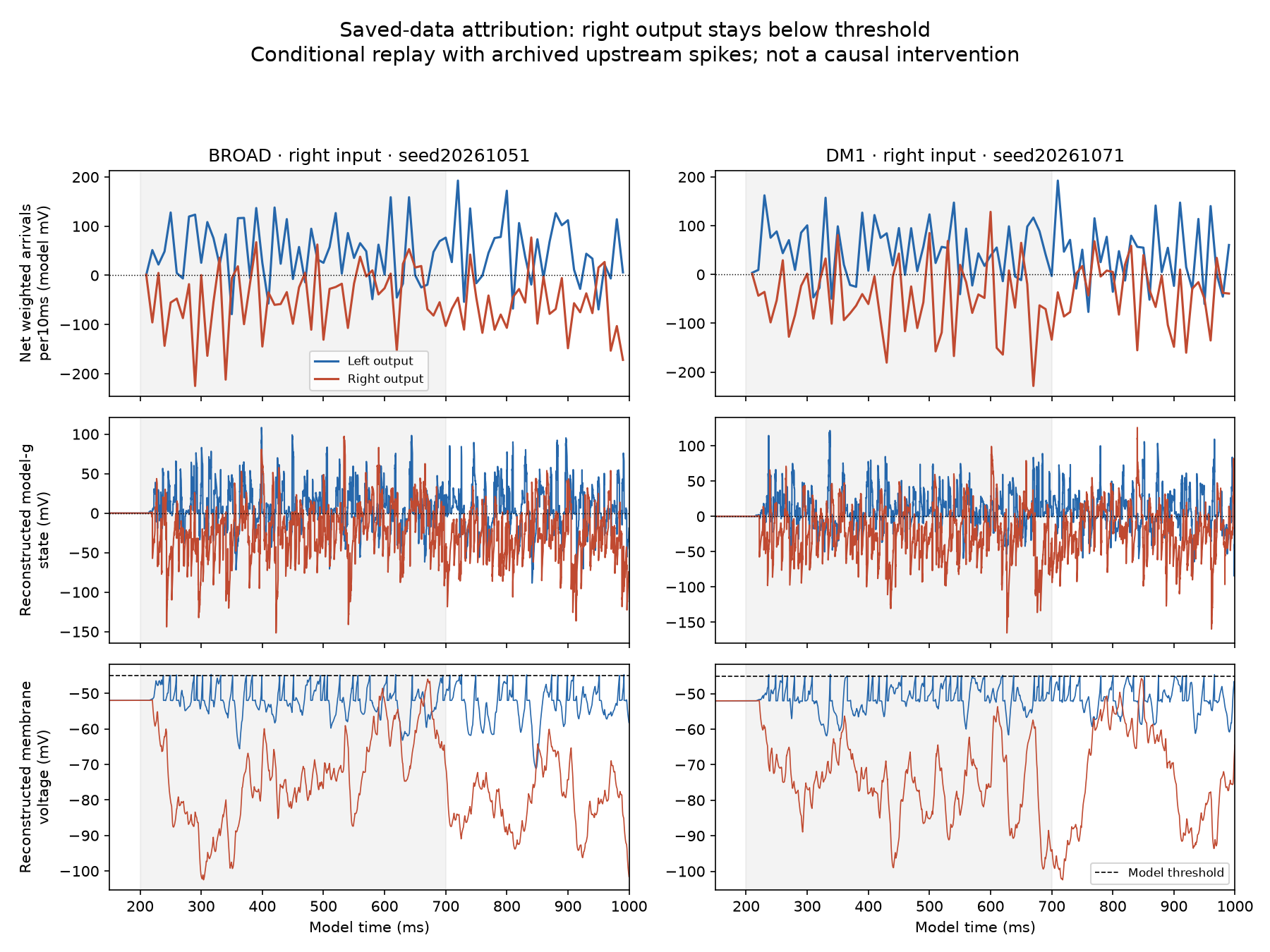
An independent saved-data checker recomputed 71,664 source/trial contribution rows, arrival bins, reconstructed metrics and original target spike times across 48 trials. Data audit passed. The original 7 source/data blobs matched before and after analysis. No original network weight was modified by this analysis, and no new full-circuit trial was run. All attribution evidence and reproduction · candidate and six right-only cases · independent audit · hashes.
Next · not run
Selectively cut only AOTU019-left→right DNa02, then restore it before a fresh paired run in the complete original circuit. Keep every other connection, test both left and right inputs on newly fixed heldout seeds, and require the original direction criterion. More right-output spikes alone would not establish steering. This intervention and any fixed kinematic plant remain not run.
The present result does not establish biological steering failure, a single causal defect, natural odor navigation, physical angular velocity, learning or driving. Both screens preserve their unsuccessful criteria. No sign flip, external action policy or selected successful seed replaces them. Brain-controlled Seoul driving remains unexecuted.
Evidence
All 54 trial results · summary · broad raw-event audit · DM1 raw-event audit · protocols, raw downloads and reproduction · source provenance · all file hashes.
Update record
-
2026-10-28: Executed the broad screen, direct excitability controls and a literature-selected DM1 follow-up with new seeds on Linux. Retained both failed direction criteria and all trials. No body or driving experiment was run.
-
2026-10-28, saved-data attribution: Recounted and conditionally replayed the existing 48 sensory trials; all target spike times match. Identified a retrospective model-negative source candidate, with no causal intervention or new full-network trial. Earlier failed direction criteria and small right-cell exceptions remain unchanged.
-
2026-10-28: Current task tracking moved to the Flyvis visual baseline. This is an editorial navigation update; the steering screens and proposed candidate intervention were not rerun.