Paired T4 separates DNp15; route cut leaves B residuals
Research record
- Question
- Do individually selective native T4 channels remain separable when paired, and does the same joint HS/H2-to-DNp15 route fully mediate their output?
- Evidence
- Pinned original full spiking circuit, the unchanged 2,701 eligible input IDs and prior single-channel diagnostic, and a source-backed HS/H2 route with eight exact original rows and 346 positive contacts. Later subtype identity transfer and artificial pulse conversion remain assumptions.
- Experiment
- Linux: 21 fresh full-network trials, three new seeds × quiet/A/B/A-B route cuts/A-B fresh restores. Two independent templates per seed; exact aggregate event times/counts shared across patterns and interventions. No food or direct HS/H2/DN stimulation.
- Results
- All six intact anatomical direction comparisons pass: A 50/0 on every seed; B 0/61, 0/63, 0/65. Quiet 0. Cut A 0/0 on every seed; cut B 0/5, 0/6, 0/8. Complete abolition fails in 3 of 6 cuts, all B seeds; driven-side decreases remain positive in all six. All six restores reproduce full-network events, actual drivers and full weight hashes. Saved-data audit: 265 checks including seven live source hashes.
- Limitations
- Synthetic direct T4 inputs and one fixed model with three input-noise seeds, not animals. No biological rate calibration, validated individual retinotopy or physical turn sign. Residual source not identified; no individual-edge necessity or unique explanation of the earlier failed visual interface. No live vision, new learning, body, autonomous steering or driving.
- Reproduction
- Frozen protocol and executed runner, pinned source/environment, all 21 full-network spike and actual-driver files, six template-count files, exact eight route rows/weights, complete saved-data auditor, descriptive tables/figure and hash manifest.
Sources
- Erginkaya et al., HS/H2 circuit study, 2025
- Original spiking model at tested commit
- Original v630 annotation source
- Later subtype annotation source
Run evidence
Result · direction passes, complete abolition fails
The single-channel T4 diagnostic separated HS/H2 activity. This follow-up pairs the native inputs. A drives the anatomically left DNp15 and B the right on all three new seeds. Cutting the fixed eight-row route eliminates A output, but leaves 5, 6 and 8 right-side spikes under B. The complete-abolition criterion therefore fails. All six fresh restores reproduce the intact full-network event record exactly.
This is direct synthetic stimulation of native sensory-processing cells. It uses no food input or direct HS/H2 or descending stimulation, and does not repair the earlier visual interface or establish behavior.
Frozen experiment · 21 fresh trials
Run 2026-10-28_paired-t4-route_v01 used the unchanged 127,400-neuron / 14,687,178-row original spiking graph on Linux, one CPU at nice 15. New seeds 20261121/22/23 each have quiet, A, B, A/B route cuts and A/B fresh restores. Duration 1 s, time step 0.1 ms, stimulus 200–700 ms, readout 200–1000 ms. Runner time: 85.56 s.
- A: T4a left plus T4b right. B: T4a right plus T4b left. All 2,701 eligible original IDs remain unchanged. Later subtype transfer is constrained by original-index and unique v630-side agreement; biological identity and individual retinotopy remain unvalidated.
- Matched input: two independent template streams per seed, each with the previous fixed expected 50,000 candidate pulses/s budget; total 100,000/s. Exact aggregate event times and counts match across A/B, and each pattern’s full actual driver events remain identical across cut/restore. Shared random keys assign distinct cells within each time step. Unequal group sizes imply unequal per-cell rates. This is an artificial model drive, not calibrated biological firing.
- Fixed model convention: all four potential input groups have refractory 0 ms in every condition; other cells retain 2.2 ms. Each admitted external pulse is 68.75 mV in this model. No gain, sign, label, margin or seed was tuned after outcomes.
- Exact intervention: only the specified 8 chemical rows from HS/H2 to DNp15, 346 positive contacts: 129 into the left and 217 into the right. These are original-model row counts, not a reproduction of the paper’s manually reconstructed matrix. Cut trials set those weights to zero. Fresh restore trials start from the original initial state, zero and reinstate those same values before simulation; they do not test recovery during ongoing neural activity. Runtime assertions compare the entire weight array with the declared original/cut array.
The primary intact criterion was A left−right≥1 spike and B right−left≥1 spike on every seed. Quiet, complete abolition after cut, positive driven-side decrease and exact fresh restoration are distinct controls. DNp15 is the fixed primary output; DNa02 is descriptive, without output substitution.
| Input seed | Intact A L / R | Intact B L / R | Cut A L / R | Cut B L / R |
|---|---|---|---|---|
| 20261121 | 50 / 0 | 0 / 61 | 0 / 0 | 0 / 5 |
| 20261122 | 50 / 0 | 0 / 63 | 0 / 0 | 0 / 6 |
| 20261123 | 50 / 0 | 0 / 65 | 0 / 0 | 0 / 8 |
Direction: 6/6 pass. Quiet has zero whole-network spikes on all three seeds. Complete abolition: 3/6 fail, specifically B on every seed 20261121/22/23. A falls 50→0; B falls 61→5, 63→6, 65→8. Driven-side decreases are positive 6/6. The cut is effective but does not abolish the B output under this operating point.
Fresh restoration: 6/6 exact. Every intact/restore pair matches the complete ordered neuron/time spike-event sequence, full actual-driver record and full weight hash. This is stronger than matching DNp15 counts alone; membrane trajectories and biological recovery were not measured.
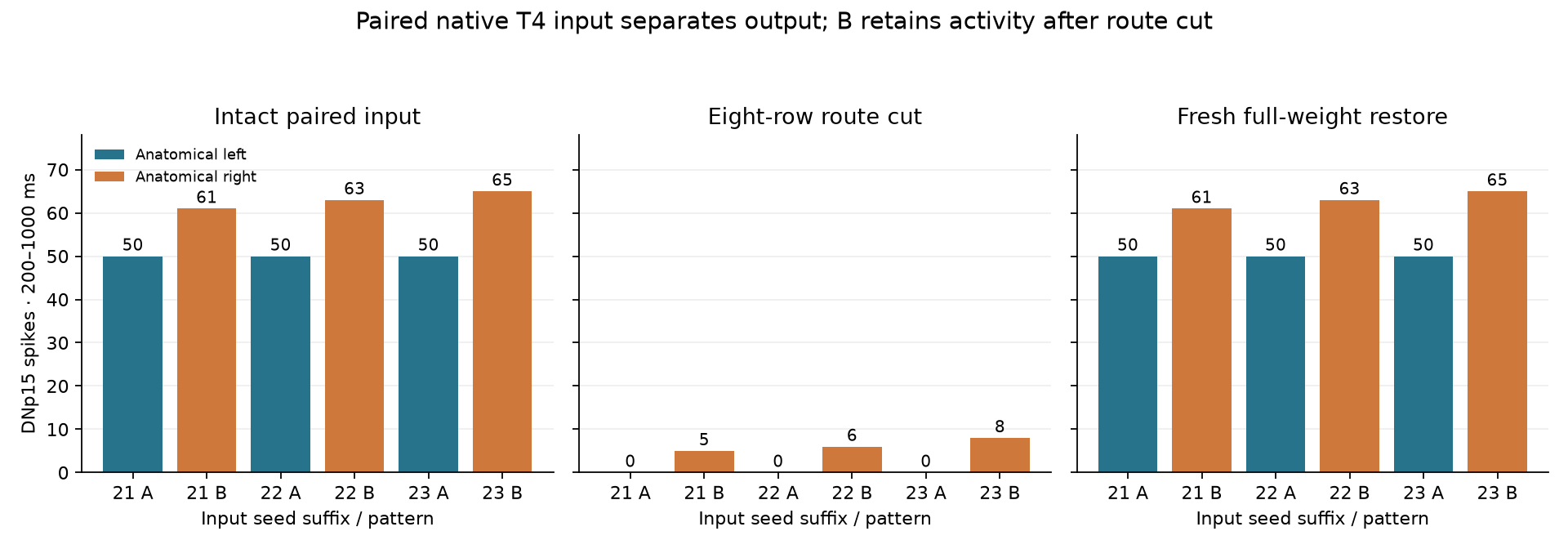
Open the full-size figure. All panels use the same count axis. Seed suffixes 21/22/23 mean 20261121/22/23; colors are anatomical left/right. The missing preferred-side bars after A cut are true zeros; B residuals are retained, not hidden.
Interpretation and next · not run
This tests paired access to anatomical output channels and the contribution of a specified route in one fixed model. It does not establish physical turning, a calibrated binocular visual stimulus or a driving policy. These are three input-noise realizations, not independent animals or models.
The earlier engineered visual bridge’s route cuts produced zero output in its own trials. This different synthetic paired-input regime has B residuals; the earlier result must not be generalized to universal route necessity. The present cut/restore supports a contribution of the 8-row set under these conditions. It does not identify which uncut inputs explain the B residual, establish necessity of individual edges, or isolate the unique cause of the failed visual interface.
Next, not run: inspect the remaining DNp15-right afferents against the saved B-cut events, distinguish a post hoc candidate from a proven cause, then freeze a targeted additional block/restore with new held-out seeds. Do not fit an encoder or flip the output sign to conceal this failed control. No new learning, body, closed-loop world, autonomous steering or driving was attached.
Evidence and reproduction
The Linux saved-data auditor passed 265 checks, including seven live original-source Git-blob checks. The portable audit has 258 checks without those optional files. These audits reconstruct saved events, matched input streams, route identities, counts, recorded weight hashes and controls; they do not independently re-run neural dynamics or export full runtime weight arrays. Original source hashes match before and after execution.
Frozen protocol, summary and separate control flags, all 21 trial counts, route effects, exact route rows, reproduction steps and the complete manifest retain sources, environment, raw outputs and limits.
Update record
-
2026-10-28: Executed the prespecified 21 trials, saved-data audit and descriptive analysis. Kept the failed complete-abolition control explicit: B residuals occur on all three new seeds. No parameters or criteria were revised after results. All six fresh restores match intact full-network events. Earlier experiments and their failures remain preserved.
-
2026-10-28: Follow-up: DNb03 residual input cut and fresh restoration. The three held-out B inputs and protocol ambiguity are documented there.