T4 channel specificity passes; visual interface still unresolved
Research record
- Question
- Do eligible native T4a/b inputs selectively drive source-backed HS/H2 channels before we change the failed visual interface?
- Evidence
- Pinned original full spiking circuit and unchanged eligible-input identities; official Flyvis source/checkpoint/recorded activity and HS/H2 circuit research. Later subtype transfer and pulse conversion remain explicit assumptions.
- Experiment
- Linux: 15 fresh full-network trials, three new input-noise seeds × quiet/four unilateral T4a/b inputs. Common aggregate event times and counts, full actual input monitors archived. Separate saved-activity audit recovers pinned source weights without new visual inference.
- Results
- All 12 fixed side/seed/channel comparisons pass. Preferred HS totals are 258–300 spikes and H2 112–122; the other subtype and quiet produce zero on these ipsilateral channels. Native DNp15 outputs also separate anatomically as a secondary observation. Saved-data audits pass 174 native checks (including seven live source hashes) and 29 source-transform checks.
- Limitations
- Direct artificial T4 stimulation, static learned/original weights, uncalibrated model pulse budget, later annotation transfer, and anatomical labels. No validated individual retinotopy, cross-model projection, physical turn sign, paired-input test, new learning, body, autonomous steering or driving. This does not identify a unique cause of the earlier failure.
- Reproduction
- Frozen protocol, unchanged executed scripts, environment locks, all full-network spikes/actual drivers, common candidate counts, neuron identities, source-weight/trace arrays, two auditors and complete hash manifest.
Sources
- Erginkaya et al., HS/H2 circuit study, 2025
- T4 subtype direction convention
- Original spiking source at tested commit
- Flyvis native synaptic-output implementation at tested commit
- Original v630 annotations
- Later subtype annotation source
Run evidence
Result
The previous visual bridge failed its direction criterion. This follow-up directly stimulates native T4 sensory-processing inputs, without food-signal inputs or direct HS/H2 or descending stimulation. T4a selectively drives ipsilateral HS; T4b selectively drives ipsilateral H2 on all three new input-noise seeds. This is a channel diagnostic, not a repaired visual interface.
Frozen experiment · 15 trials
Run 2026-10-28_t4-channel-specificity_v01 used the unchanged 127,400-neuron / 14,687,178-row original circuit on Linux, one CPU at low priority. Seeds 20261111/12/13 each have quiet plus T4a left, T4b left, T4a right and T4b right conditions. No gain search, label reversal or output selection followed the results. Runner time: 60.41 s.
All 2,701 eligible original input IDs were retained: left a/b 640/684, right a/b 662/715. Later subtype labels are still an annotation-transfer assumption, constrained by original-index membership and unique v630-side agreement; they are not independent biological identity validation.
Each active condition has an expected aggregate 50,000 candidate pulses/s during 200–700 ms, retaining the previous interface’s fixed per-eye ceiling as a diagnostic budget. Candidate event counts and times are exactly shared across conditions within a seed. Shared random keys assign distinct cells within each time step. Unequal population sizes therefore imply unequal per-cell rates; this is not a calibrated biological stimulus. Quiet retains candidate events with gate zero. All four potential input groups use the author’s stimulated-cell refractory-zero convention; other cells retain 2.2 ms. The pulse amplitude remains 68.75 mV in this model. Weights remain unchanged.
The fixed criterion compares T4a versus T4b within the same anatomical side: HS total under a must exceed b by at least one spike; H2 under b must exceed a by at least one. Each preferred response must also exceed quiet by at least one. This gives 12 comparisons across two sides, two readouts and three seeds. HS totals sum HSN/HSE/HSS; we do not compare a three-cell HS total with a single H2 cell to define preference. Counts cover 200–1000 ms.
| Input seed | Side | HS after T4a | HS after T4b | H2 after T4a | H2 after T4b |
|---|---|---|---|---|---|
| 20261111 | left | 300 | 0 | 0 | 113 |
| 20261111 | right | 258 | 0 | 0 | 120 |
| 20261112 | left | 299 | 0 | 0 | 112 |
| 20261112 | right | 258 | 0 | 0 | 120 |
| 20261113 | left | 300 | 0 | 0 | 112 |
| 20261113 | right | 258 | 0 | 0 | 122 |
All 12 comparisons pass. Quiet pathway counts are zero. Individual noise seeds produce small count changes, without an exception to this criterion. These are three input-noise realizations of one fixed model, not independent animals or a population estimate.
Secondary DNp15 counts are anatomically left-only for T4a left and T4b right, and right-only for T4a right and T4b left on all three seeds. This is descriptive: the experiment did not prespecify a descending success criterion, test paired binocular inputs or establish physical turning. All primary, contralateral and descending counts are in the 15-trial table.
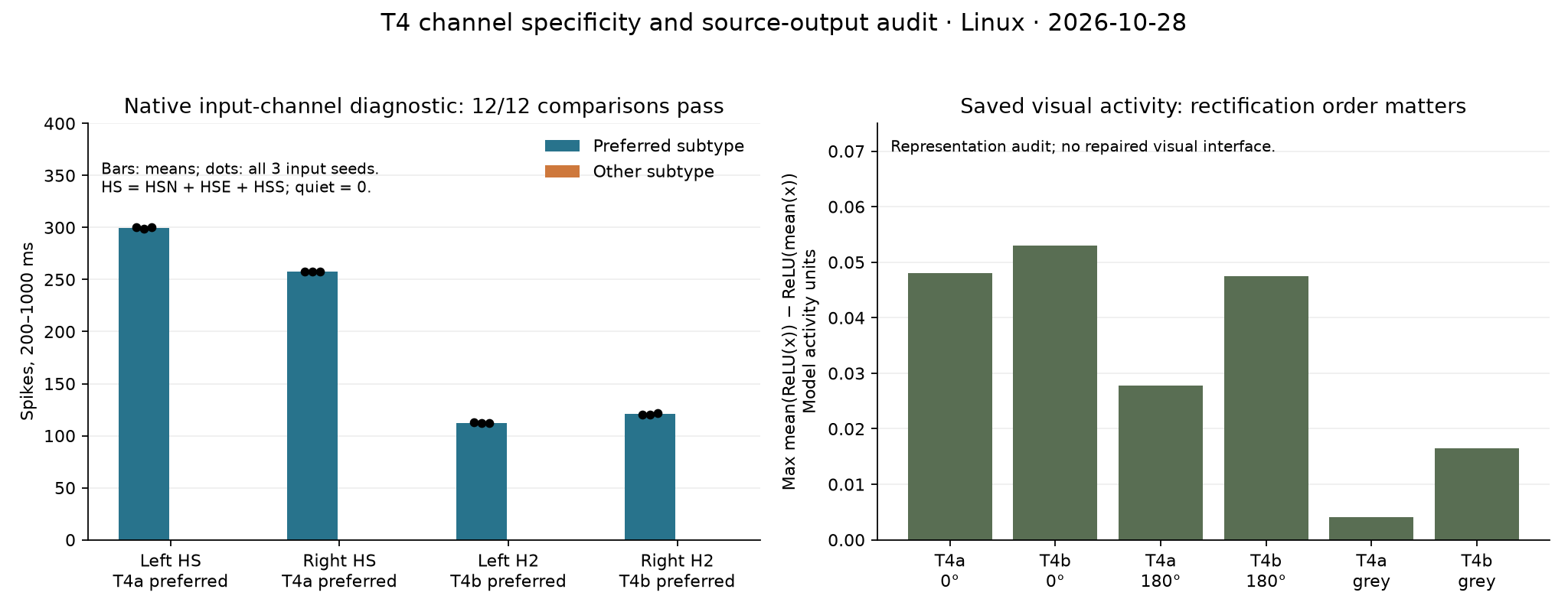
Open the full-size figure. Left: bars are means and black dots show all three seeds; the other subtype has zero ipsilateral response. Right: the maximum rectification-order gap across time for each saved movie/type pair, in model activity units.
Source-output audit · no new visual inference
We recovered the same official Flyvis checkpoint, confirmed its actual activation is ReLU, and checked that the learned parameter hash is unchanged. The pinned source applies rectification per source neuron before synaptic weighting and summation. Our earlier interface averaged first, subtracted its pre-motion mean and kept positive changes. Those are different operations and reference levels.
On the saved arrays, mean(ReLU(x)) − ReLU(mean(x)) reaches 0.0529274 model activity units. The earlier positive-change encoder was also reconstructed exactly. As an additional descriptive calculation, the audit exported per-source sums of native outgoing weights and recomputed the summed weight × ReLU(activity) contribution of the saved T4a/b cells. This sum spans their outgoing edges, excludes other source types and precedes target integration; it is not the full model current, biological current or an HS/H2 mapping. Rectifying first and subtracting a baseline are separate differences; neither the numerical gap nor this successful direct stimulation establishes the unique cause of the earlier visual failure.
Evidence and next step
The native saved-data audit passed 174 checks, including seven live original-source Git-blob checks. The portable native audit has 167 checks when the seven optional live Linux source files are unavailable. The source-transform arithmetic audit passed 29 checks. All full-network spike events and actual driver-monitor events are archived for every condition; common candidate counts are also saved. Source hashes before and after match. These audits reconstruct saved results and arithmetic; they are not independent neural reruns or biological validation.
Main frozen protocol, native summary, transform summary, reproduction steps and the manifest retain the exact versions, controls and limits.
Next, not run: paired native T4 inputs with new held-out seeds, followed by joint HS/H2→DNp15 cut/restoration. Freeze that plan before examining outcomes. This would test whether the separately accessible channels remain separable when combined, before revising the visual projection. No body, closed-loop world, new learning, autonomous steering or driving has been attached.
Update record
-
2026-10-28: Executed the frozen 15-trial native-channel diagnostic and saved-activity/source-weight audit. All fixed channel comparisons passed. The earlier failed visual bridge remains unchanged. Plot layout v02 adds headroom for annotations; its underlying counts and metrics match v01, which remains preserved privately. No neural rerun or criterion change accompanied this editorial correction.
-
2026-10-28: Editorial task tracking moved to the paired-input route experiment, including its failed complete-abolition control. This preserves the single-channel result and does not rerun or repair the earlier visual interface.